Share This

Friday, 26 September 2025

Foreign media ‘stunned, surprised’ by aircraft carrier Fujian’s electromagnetic catapult-assisted aircraft launches


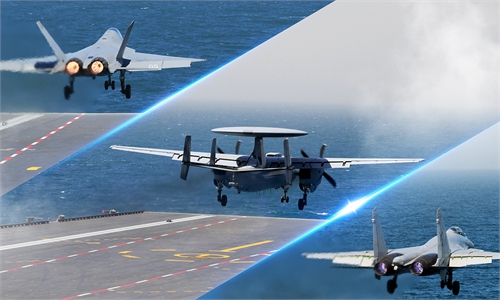
 China's first electromagnetic catapult-equipped aircraft carrier, the Fujian, has achieved a breakthrough by hosting the first catapult-assisted takeoff and arrested landing training for the J-15T heavy fighter jet, the J-35 stealth fighter jet, and the KJ-600 early warning aircraft, the Chinese People's Liberation Ar the links into your  my (PLA) Navy announced on September 22, 2025. Photo: China Military Bugle


China's first electromagnetic catapult-equipped aircraft carrier, the Fujian, has achieved a breakthrough by hosting the first catapult-assisted takeoff and arrested landing training for the J-15T heavy fighter jet, the J-35 stealth fighter jet, and the KJ-600 early warning aircraft, the Chinese People's Liberation Army (PLA) Navy announced on September 22, 2025. Photo: China Military Bugle


The latest breakthrough made by China's aircraft carrier Fujian has attracted wide attention from foreign media outlets, with one of them saying the move was "a stunning leap forward" of China's aircraft carrier capability, while another called the sudden release a surprise. This comes after the Chinese People's Liberation Army (PLA) Navy on Monday announced that the J-35 stealth fighter jet, J-15T heavy fighter jet and KJ-600 early warning aircraft had completed catapult-assisted takeoff and arrested landing training on China's third aircraft carrier, the electromagnetic catapult-equipped Fujian.


Chinese experts said the new carrier, expected to enter service soon, will elevate the PLA Navy's capability to new heights.


The only other aircraft carrier in the world that has the EMALS (electromagnetic aircraft launch system) is the US Navy's newest carrier, the USS Gerald R Ford, which was certified for flight deck operations using the EMALS system in the spring of 2022, CNN noted in its report on the Fujian's technological breakthrough on Tuesday.


The EMALS system allows carrier aircraft to take off with heavier weapon and fuel loads than those operating off China's two older carriers, the Shandong and Liaoning, which feature ski-jump-type take-off ramps, enabling Fujian's aircraft to strike enemy targets from greater distances, CNN said. The report also quoted analysts as saying that the Fujian's ability to launch larger warplanes carrying higher munitions loads to farther distances will give the carrier a greater combat range than its predecessors in the Chinese fleet, providing the PLA Navy with blue-water capabilities.


Furthermore, The War Zone, a US-based defense specialist outlet, noted that not even the US Navy's USS Gerald R. Ford has ever launched a stealth fighter jet like the Fujian has done with the J-35. "[The Ford] has not launched an F-35C so far, making the J-35 the first stealth jet to achieve this feat. Based on earlier predictions, the F-35C may not do the same for some years," The War Zone wrote in a Monday article titled "China's Aircraft Carrier Capability Just Made A Stunning Leap Forward".


Naval News said on Tuesday that the "sudden release" by the Chinese military has taken the wider online commentariat somewhat by surprise. It noted that while the announcement was made on Monday, the flight operation-footage likely dates to earlier in 2025. Circumstantial evidence supporting this notion is again the particular condition of the ship at the time.


USNI News, the news website of the US Naval Institute, on Monday quoted analyst Ben Lewis as saying that the Fujian's test was a "significant milestone" for the Chinese military's carrier program.


"While it appears likely that the tests were done earlier this year, the choice to release the footage during Fujian's ninth sea trials suggests that Fujian will likely be ready for commissioning in the near future," Lewis said.


Chinese military affairs expert Zhang Junshe told the Global Times that with the Fujian's latest breakthrough, China is becoming a major aircraft carrier power, with both the carrier and its aircraft achieving world-class in key metrics.


This not only showed that the PLA has fully mastered and matured the application of complex electromagnetic catapults, but also reflected the continuous improvement in the capability and proficiency of naval personnel in operating high-tech equipment, Zhang Junshe said.


With the boost from electromagnetic catapults, the Fujian carrier formation can greatly expand its combat radius to cover as far as the second island chain in the Western Pacific, Zhang Junshe noted.


In response to a media request for comments on analyses claiming that the future commissioning of the aircraft carrier Fujian, the strike range of which will cover the second island chain, will surely change the strategic landscape in the Western Pacific region, and that some US analyses claimed that the Fujian will threaten US military deployment in the first island chain, Chinese Defense Ministry Spokesperson Zhang Xiaogang said at a regular press conference on Thursday that China always adheres to a defensive national defense policy.


The development of China's weapons and equipment is solely for safeguarding national sovereignty, security, and development interests. China will always be a force for peace, stability, and progress in the world, the spokesperson said.


Thursday marks the 13th anniversary of the commissioning of China's first aircraft carrier, the Liaoning, with September 25, 2012 becoming the start of an era when the PLA Navy started aircraft carrier operations.


Zhang Junshe, the expert, further noted that the experience and exploration gained from the Liaoning have provided significant reference and assistance for the operation, training, and deployment of subsequent aircraft carriers, leading to a substantial enhancement of China's integrated combat capabilities for aircraft carriers.


From having no aircraft carrier to commissioning its first one in 2012 to now entering an era with three, China's naval capabilities have advanced rapidly.


"The PLA Navy will also have greater confidence in safeguarding maritime rights and interests and carrying out missions on the far seas," said Han Wei, a professor at the PLA's Naval Aviation University, the Xinhua News Agency reported.


The electromagnetic catapult-assisted takeoff and arrested landing training on the Fujian will powerfully drive a generational leap in the integrated combat capabilities of the aircraft carrier formation, providing crucial support for conducting far seas combat missions and accelerating the navy's strategic transition from near seas defense to far seas defense, Han said.


Looking into the future, Zhang Junshe said in an interview with the military channel of China Central Television (CCTV) that China's aircraft carrier program still has significant room for development. 


According to Zhang Junshe, future carriers will transition to utilizing catapult-assisted takeoff in terms of launch systems, while regarding propulsion, the direction is toward developing nuclear-powered carriers, CCTV reported.


Enhancing the PLA Navy's combat capabilities essentially translates to an increase in strength for safeguarding world peace, contributing to better defending the country, fulfilling international responsibilities and obligations, and maintaining global peace and stability, Zhang Junshe said.


When asked to confirm foreign media reports claiming that China's fourth aircraft carrier, also the first nuclear-powered one, is under construction at Dalian Shipyard, Chinese Defense Ministry spokesperson Zhang Xiaogang told the Global Times at a regular press conference on Thursday that he was not aware of the specific situation. He emphasized that China's aircraft carrier development is always conducted in accordance with national security needs and the progress of equipment technology. - Liu Xuanzun

RELATED ARTICLES

All routes lead to China


After a US$1 trillion investment, the e has evolved into a global infrastructure and economic strategy involving more than 150 countries.


Two months ago, China inaugurated a new train service that adopts a sea-road-rail intermodal approach, reducing the transit time to about 18 days for about 4,300km – more than a 50% increase in efficiency – and notably avoids passing through the Strait of Malacca.

Its full name, the “Zheng He” Sea-road-rail International Multimodal Transport Service, departs from Kunming, carrying 26 containers of Yunnan specialities, including vegetables, fertilisers and animal feed. It then traverses the China-laos Railway to Vientiane, Laos, and then divides into three routes to complete the transportation.

Route one transfers to the Thai railway network to reach Changwat Saraburi in Thailand, route two connects to road transport to Laem Chabang Port in Thailand, followed by sea freight to Singapore.

And route three connects to road transport to Ranong Port in Thailand, then by sea to Yangon Port in Myanmar, and thence by sea to Chittagong Port in Bangladesh.

Named after the renowned navigator Zheng He, a favourite son of Kunming, this amazing feat of engineering has opened up goods from the mainland and Yunnan specifically to new markets, saving costs and resources.

One of these new markets could potentially be Malaysia.

With China being Asean’s largest trading partner, Malaysia’s geographical position makes it a crucial node for the Maritime Silk Road, with its ports and infrastructure playing a pivotal role in regional connectivity and trade.

A key BRI initiative is the East Coast Rail Link (ECRL), a massive infrastructure project connecting the east and west coasts of the peninsula with 20 stations along its route.

Construction work for the 665km railway project has reached 86% completion as of July, despite several hiccups and challenges throughout its development and implementation phases. It is expected to be completed by the end of 2026.

Aimed at improving connectivity and stimulating economic development, the project traversing Kelantan, Terengganu, Pahang and Selangor is set to be an economic game changer, especially in boosting Malaysia’s transportation network.

Travel time between Kota Baru and the Klang Valley is anticipated to be around four hours, compared to seven hours or more by road during festive seasons.

In March, Investment, Trade and Industry Minister Tengku Datuk Seri Zafrul Abdul Aziz said the ECRL will serve as a catalyst for socioeconomic growth and is expected to increase the country’s GDP by 3.78% by 2047. - 

In April, the Malaysian Investment Development Authority said the ECRL is anticipated to generate RM1.4 trillion for Malaysia’s economy by 2047 with a focus on industrial parks, logistics hubs and transit-oriented developments.

The numbers quoted are impressive, but for the ECRL to truly be effective, there must be a further rail connection with the Thai rail network.

There has been talk of extending the ECRL from Kota Baru to the Sungai Golok border in Thailand to create a seamless connection. This in turn can ensure a transfer of goods from Yunnan and vice versa.

While talks are ongoing between the Thai and Malaysian governments, there are obstacles in the way. Flood risks in the low lying Rantau Panjang stretch is a worry, as is track compatibility because the ECRL uses a standard gauge (1.435m wide), while the State Railway of Thailand uses a 1m gauge.

Technical issues aside, there is political consensus to see the connection happen and it would stimulate trade between the two countries.

As the BRI evolves, it is prompting discussion and debate as to its optimal scale, design, benefits and impact. What cannot be denied is that this initiative continues to be a significant geopolitical force, with its influence on regional and global development being recognised worldwide.

This is no longer a speculative blueprint; it is the largest modern infrastructure initiative in human history. - by ),Brian Martin,

Thursday, 25 September 2025

The evolution of Malaysian foreign policy

Kuala Lumpur once prized non-alignment above all else – now it sees Beijing as more reliable than lectures from the West.- Murni Abdul Hamid


Malaysian Prime Minister Anwar Ibrahim during a parade for Malaysian Independence Day celebrations last month in Putrajaya, Malaysia (Syaiful Redzuan/Anadolu via Getty Images

Malaysia’s approach in navigating great power rivalry since the Cold War has largely been based on the principles of non-alignment, neutralism, and equidistance. However, two contrasting snapshots of the country’s Independence (Merdeka) Day celebration – half a century apart – offer an interesting perspective on whether Malaysia’s contemporary position has shifted away from these principles.

On 31 August 1973, Malaysia’s second Prime Minister, Tun Abdul Razak, hastily left the joyous Merdeka celebration midway to depart for Algiers and lead the Malaysian delegation to the Non-Alignment Movement (NAM) Summit. It was his first time attending the summit. It had taken several attempts for Malaysia to become a NAM member, largely due to Indonesia’s opposition and influence within the Afro-Asian group during the Konfrontasi period. Malaysia’s experience of Konfrontasi and the retreat of the British from the region pushed the country to seek friends among other newly independent states.

When Malaysia finally became a NAM member in 1970, its foreign policy gradually shifted away from heavy reliance on the United Kingdom toward a more neutral and non-aligned stance. Against this background, Tun Razak strongly felt the need for Malaysia to be represented at the highest level in Algiers to signify the country’s commitment to non-alignment – even if it meant leaving the Merdeka celebration halfway.

Bettmann
Malaysia’s second Prime Minister, Tun Abdul Razak (Bettmann/Getty Images)

Jump forward just over 50 years to 31 August 2025, Malaysia’s tenth Prime Minister, Anwar Ibrahim, left at the conclusion of the nation’s Merdeka celebration to immediately depart for China to attend the Shanghai Cooperation Organisation (SCO) Summit. It was the first time Malaysia had participated in the SCO, in which Malaysia is neither a member nor an observer. It was also the first time a Malaysian leader attended China’s “Victory Parade” in Beijing, which this year took place a few days later, to commemorate the end of the Second World War, alongside other leaders including from Russia, North Korea, Indonesia, Vietnam, Laos, Cambodia, Myanmar, and Iran.

Since becoming Prime Minister in late 2022, Anwar has visited China four times, with China’s President and Premier reciprocating accordingly (also a total of four times if including the upcoming ASEAN Summit and other meetings next month).

While China has been Malaysia’s largest trading partner since 2009, relations with China have further intensified in recent years both bilaterally and multilaterally. These include Malaysia’s active involvement in the Belt and Road Initiative (BRI), and participation in the Regional Comprehensive Economic Partnership Agreement (RCEP). Stronger ties also extend to decisions to allow Chinese companies to develop the country’s second 5G network and to revitalise Malaysia’s national car industry, the recent acceptance of China’s vision of building a Community with a Shared Future for Mankind, and the landmark creation of a bilateral mechanism with China to discuss maritime issues. Malaysia’s decision to join BRICS, and the initiative to bring in China into the ASEAN-GCC platform by hosting the first-ever ASEAN-GCC-China Summit in Kuala Lumpur, also illustrate the depth of relations.

The actions of the great powers leave little room for Malaysia to manoeuvre, and siding with the more predictable and reliable power seems to be the less risky option.

While Malaysia’s intensification of cooperation with China should not be viewed as a zero-sum game, it is hard to ignore that this occurred against the backdrop of deteriorating relations with the United States. From the perspective of Malaysian leaders, the more benign power and trusted partner today is not the United States, but China. This, in spite of several challenges, particularly in the South China Sea.

In Anwar’s speech during President Xi Jinping’s visit to Malaysia earlier this year, he praised China as a rational, steady, and reliable partner amid the turbulence of “economic tribalism” and threats to multilateralism and the rules-based order. Last year, when Anwar spoke off-the-cuff at a business luncheon in honour of Premier Li Qiang in Kuala Lumpur, he commended the attitude of the Chinese leadership as “friendly, courteous, full of respect, [and] understanding of cultures and differences”, in contrast to the “narrative from the others” and the “barrage of questions” from others – especially “the western” – on whether Malaysia’s close relations with China would be in Malaysia’s best interest.

Understandably, as an independent nation, no country appreciates being told who it should be friends with, especially when those doing the lecturing neither act as they preach nor have been reliable friends in the first place.

While closer relations with the United States would still serve Malaysia’s interests – particularly in the realms of the economy and defence – they are proving even more elusive under President Donald Trump. His arbitrary tariff impositions, aggressive rhetoric (even against allies), withdrawals from multilateral organisations, disregard for the rule of law, undermining of the global order, and coddling of Israel have been obstacles for Malaysian leaders in promoting closer ties with the United States. Domestically, various opinion polls in recent years have shown a steady decline in Malaysians’ favourable perceptions towards the United States, while favourable views of China and even Russia have increased significantly.

If the above trend persists, Malaysia might find itself moving even further away from its non-aligned, neutral, and equidistant stances that served it well in the past. At present, however, the actions of the great powers leave little room for Malaysia to manoeuvre, and siding with the more predictable and reliable power seems to be the less risky option.


Source link


Is the US really losing to
China in Southeast Asia?

A major new research project published by the Lowy Institute says yes – but there’s more to the story