
Cases of stolen identity, couterfeit products
PETALING JAYA: What was first a mere question from a friend about discounted products quickly turned into a worrying discovery for pharmacist Rachel Gan May Shiang.
Someone was using her pharmacy’s identity to sell doubtful products.
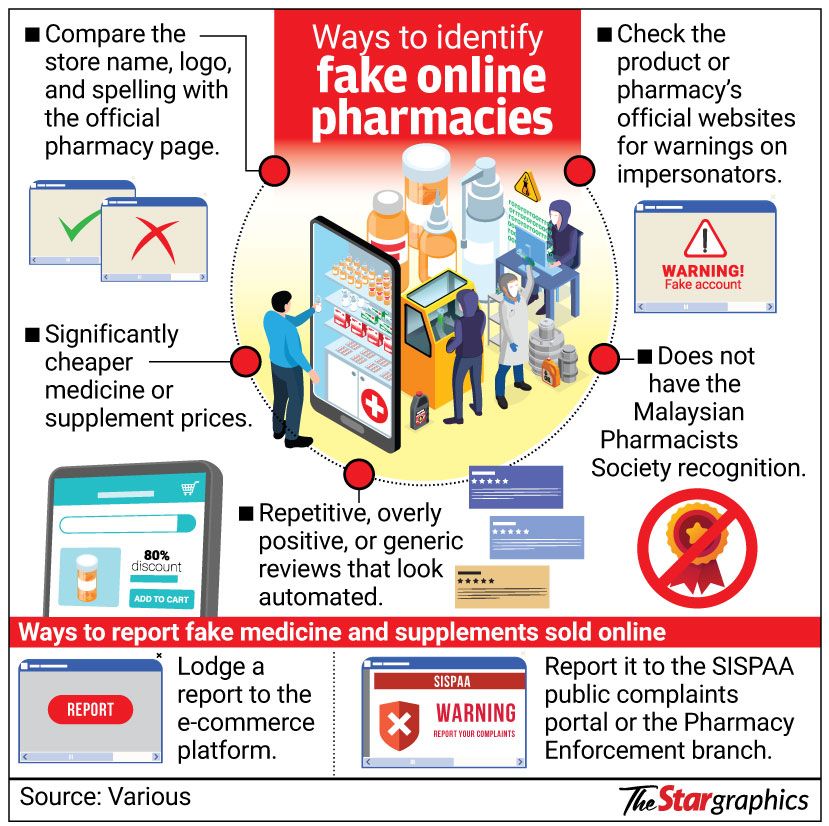
“The store looked almost identical. The only difference was that one of the letters bore a small alphabet as opposed to mine.
“Unregistered products in the Malaysian market were also sold on that site,” said Gan, who founded a pharmacy in Kota Kemuning, Shah Alam.
This led to complaints being made to the said e-commerce platform. Several of the product postings were then removed.
Days later, however, more fake accounts emerged.
“What’s even more worrying is that these products are being purchased.
“Besides the impersonation, there are wider public health concerns,” she said.
Gan, who is honorary secretary of the Malaysian Community Pharmacy Guild, questioned how the said platform vets its sellers, especially for those related to sectors such as pharmaceuticals.
Her case is not an isolated one, as even chain pharmacies are being targeted by fraudulent operators.
“Over the past year, we noticed this becoming increasingly rampant.
“At first, we received customer enquiries, with many also checking the authenticity of the products at our physical stores.
“So we checked the sites daily and lodged reports with the relevant authorities every time our brand name is misused to sell health and supplement products,” said Alpro Pharmacy professional care and development manager Ng Yi Ling.
These stores impersonate the Alpro brand, logo and images, she said.
The only difference was in the capitalisation of the letters in the brand name.
“Our biggest concern is how consuming these products will impact the health of consumers. We do not know the contents of these products,” she said.
Du Kiat Seng and Ng Seng Wei, who are the brand owners and sole distributor of a supplement product in Malaysia, said they have received complaints about counterfeit products as recently as March.
“We tried ordering the product ourselves and found that it was clearly a counterfeit.”
The giveaway was the absence of mandatory hologram tags.
The registration number was also a duplicated one, they said.
Both of them found that posts of doubtful products would be taken down following complaints but they would reappear the next day on the same online store.
“There should be some sense of responsibility from platforms to do their due diligence before allowing anyone to list health products for sale online.”
Brego Life Sciences marketing manager Claris Wong said they discovered such issues happening since 2024.
“We received complaints online. The prices were between 30% and 40% cheaper.
“We purchased the products and saw that they were almost identical with our products, although there were subtle differences in the printing.
“There was even a hologram printed on it. But when we scanned it, we found the product was not registered,” she said.
Sh said there was an instance where a customer was hospitalised after consuming a counterfeit product.
“Counterfeit products are dangerous.
“Our tests revealed that they do not have any of the active ingredients as claimed and may also contain unknown or harmful substances,” she said.
Related stories:
Save a dime, risk a life? Beware of cheap fake meds online
PETALING JAYA: It may seem like a good bargain online. But it comes with serious risks, as counterfeit medicines and supplements are still being sold on e-commerce platforms despite ongoing crackdowns.
TikTok Shop Malaysia said medicines and supplements are subject to requirements, including the need for a MAL number or notification from the National Pharmaceutical Regulatory Agency (NPRA), before being listed.
“Through our Intellectual Property Protection Centre, brands or authorised representatives can submit takedown requests for products and monitor their st
“There is no finish line when it comes to safety. Users are encouraged to report these products, content and sellers through the in-app reporting channel,” said a spokesperson.
TikTok Shop Malaysia is working with the Domestic Trade and Cost of Living Ministry and Health Ministry to address evolving forms of circumvention.
The spokesperson said continuous investments are made to improve safety tools, technology and personnel, with more than US$1bil committed globally to protect users from fraudulent and dangerous activities.
Automated systems are also used to detect potential fraud, infringement, unsafe content or violative product listings, both before and after products or content are uploaded.
“Sellers must submit official documentation during registration, which is then verified against business and banking details to ensure authenticity.
“Store names are subject to strict guidelines to prevent misrepresentation, including restrictions on terms such as ‘official’, ‘flagship’ or ‘authorised’,” the spokesperson said.
Once approved, new sellers undergo a probationary period where daily orders and product listings are capped as they familiarise themselves with platform policies.
Between January and June this year, it said more than 70 million product listing attempts were rejected globally for policy violations, with a proactive removal rate exceeding 99.5%.
Some 1.4 million seller account registration applications that failed to meet its standards were declined, with more than 700,000 sellers removed during the same period due to shop-level violations.
“More than 900,000 reports from users viewing TikTok Shop videos or live streams were also reviewed,” the spokesperson said.
Shopee strictly prohibits the sale of counterfeit and prohibited items too, requiring all sellers to comply with local regulations and platform policies.
A spokesperson said the platform works closely with the Malaysian Pharmacists Society (MPS) to verify pharmacies and actively remove listings that violate its rules.
“We are committed to building a safe and trusted platform where shoppers can transact with confidence.
“We also use proactive monitoring and work with brands, law enforcement and the Health Ministry to detect and take action against sellers breaching our policies, including account suspension, permanent bans and, where appropriate, legal action.
“Users are encouraged to report suspicious or counterfeit products via the ‘Report this Product’ option.”
Complaints can also be made to the Public Complaints Management System (SISPAA), which is used to manage public complaints, including reports of fake or unregistered medicines.
MPS president Amrahi Buang said all pharmaceutical products sold online must be registered with the Health Ministry and comply with laws including the Poisons Act, Sale of Drugs Act and the Medicines (Advertisement & Sale) Act and Regulations.
“Legitimate products have the Health Ministry hologram tag and the MAL number,” he said, adding that the number can be checked at the NPRA website.
He said MPS also signed a memorandum of understanding (MOU) with an e-commerce platform to curb the sale of counterfeit drugs online.
There are several conditions to be fulfilled when applying to open an online store as per the MOU, including having a licensed pharmacist, ensuring the products sold online can be tied to a physical store and confirming that the pharmacist is an MPS member.
“Pharmacists can check if the product is legitimate and advise you.
“We don’t just sell drugs. We want the best for our customers,” he said


No comments:
Post a Comment
rightwaystosuccess@gmail.com